Making Money Matters on a Flower Farm
Wanting a profitable flower farm does not make you selfish.
There is a point in the season when the buckets are full, the cooler smells like fresh stems and damp foliage, and you are still wondering why the bank account does not match the amount of work you are doing. A lot of flower farmers say they want a profitable flower farm. They want to pay themselves. They want less stress. They want their business to support their family and give them a little breathing room.
But then when you look at how time, money, and energy are actually being spent, the daily actions do not always match those goals. The calendar is packed with seeding, planting, harvesting, arranging, and tweaking bouquet recipes, but there is no real time set aside for pricing, marketing, sales, record keeping, or looking at the numbers. And that is where the real conversation starts.
It is okay to want your flower farm to make money. It is okay to want a flower farming business that pays you well, supports your household, and gives you financial security. Wanting profit does not mean you love the flowers less. It means you are building a business that can actually last.
Flower Farm Profitability Starts With Your Relationship With Money
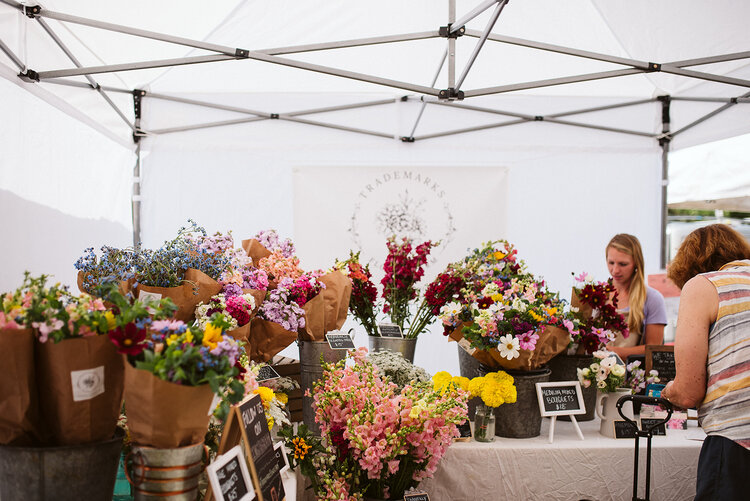
A lot of flower farmers are not struggling because they do not work hard enough. Honestly, most are working too hard. They are up early cutting stems, hauling buckets, loading the van, setting up market displays, answering messages, and collapsing at the end of the day wondering why it still does not feel like enough.
Sometimes the issue is not just a profitability problem. Sometimes it’s your relationship with money. If deep down you feel guilty charging what your flowers are worth, avoiding your numbers, or treating profit like something you are not “supposed” to want, those beliefs will quietly shape every decision you make.
You might undercharge for bouquets because you do not want anyone to think your flowers are too expensive. You might keep growing unprofitable crops because they are pretty or because customers occasionally ask for them. You might avoid following up with a bulk bucket inquiry because selling feels uncomfortable.
But building a profitable cut flower farm requires decisions based on facts, not guilt.
Profit Is What Keeps a Sustainable Flower Farm Business Alive
Profit is not selfish. Profit buys groceries. Profit pays the mortgage. Profit puts gas in the truck, replaces worn-out equipment, fixes the cooler when it quits, and gives you the option to hire help when the season gets too heavy to carry alone.
A sustainable flower farm business is not just sustainable for the soil, the flowers, or the customers. It has to be sustainable for you, too. If you are constantly overworking, undercharging, and underpaying yourself, resentment will eventually creep in. Not because you do not love the work, but because love alone does not pay the bills.
Flower farm profitability gives your business staying power. It allows you to keep serving customers year after year, create jobs, support your family, invest in your farm, and build something that does not burn you out by August. Money is not everything, but pretending it does not matter doesn’t help anyone.
If You Want to Make Money Flower Farming, Your Calendar Has to Prove It
A profitable flower farm is not built only in the field. It is built in the quiet, sometimes uncomfortable business tasks that are easy to push aside. Looking at your sales numbers. Tracking flower farm expenses. Calculating crop profitability. Following up with customers. Sending the email. Posting the offer. Raising your prices when the math says you need to.
If profitability is one of your goals, your weekly calendar should reflect that. Not someday. Not after the season slows down. Not once everything feels perfect. Every week, there needs to be time dedicated to the things that actually make money flower farming possible.
That might look like reviewing which flowers made the most profit last season, cutting a low-performing sales channel, improving your marketing system, or finally pricing your flowers for profit instead of fear. The tasks may not feel as fun as walking through the field at golden hour with armloads of blooms, but they are what allow you to keep having those moments.
Paying Yourself Isn’t Optional
There are flower farmers making $100,000, $150,000, or even $200,000 in sales and still not paying themselves enough. That is a hard truth, but it matters. Revenue alone does not mean your flower farm is profitable. Sales alone doesn’t mean your business is supporting you.
Paying yourself as a flower farmer has to become a real priority, not an afterthought. You are the one taking the financial risk. You are the one putting in the sweat, the long days, the decision-making, and the responsibility. If your business never pays you properly, it is not truly working yet.
This is why knowing your numbers matters so much. You cannot price for profit if you do not know what it costs to grow your flowers. You cannot make smart decisions if you do not know which crops, products, or sales channels are actually making money. The more clearly you can see the numbers, the easier it becomes to stop guessing and start making decisions that move your farm forward.
The Real Question for Every Flower Farmer
If someone followed you around for the next 30 days, would they be able to tell that profitability is one of your top priorities?
Not because of what you said you wanted, but because of what you actually did.
Would they see you reviewing your numbers? Improving your marketing? Following up with customers? Raising prices where you need to? Cutting what is not working? Or would they see you staying busy with tasks that feel productive but do not actually build a profitable flower farming business?
You are allowed to love the flowers, care about your customers, steward the land, build a mission-driven business, and make money. Those things are not in conflict with each other. A profitable flower farm gives you more stability, more options, and more ability to keep doing the work you love.