Are Flower Trucks Actually Worth It? The Honest Answer with Wild Iris Flower Co. (SFFF88)
Running a flower farm as a parent often means building the plane while you are flying it. There is always another crop to try, another sales channel to add, and another opportunity that feels like it could be the thing that takes your business to the next level. In this episode, Jenny Marks talks with Christine Covino of Wild Iris Flower Farm about what it looks like to build a farm with ambition and then intentionally reshape it into something sustainable.
Christine grows on about a half acre in Ridgefield, Connecticut and sells through farmers markets, seasonal CSAs, workshops, and a vintage flower truck that has become part of her identity. Like many growers, she started by saying yes to a lot. She grew a wide range of varieties, explored multiple revenue streams, and learned quickly that more options can also mean more stress, more decisions, and more time spent managing complexity.
When you stop trying to do everything, the business gets clearer
Christine shared that early on she was selling wholesale, doing event work, running the truck, managing subscriptions, and trying to keep up with every request that came in. That mix can sound like security because you are not relying on one outlet. But it can also scatter your attention and make it hard to do any one thing well, especially during peak season.
As she stepped back and looked at what was actually working, she narrowed her focus. Wholesale became a smaller part of the picture, limited to a few florists she genuinely loves working with. Event design became occasional rather than central. The business model shifted toward outlets that felt simpler to fulfill and more aligned with family life, including farmers markets, the CSA, and in person workshops where customers can interact directly with the flowers.
Cutting work that drains you is a valid business decision
One of the most grounded takeaways from this conversation is that joy matters, and it is not separate from profitability. Christine explained that event design required a level of communication and expectation management that felt heavy. Even when you are clear that you are a flower farm working with seasonal availability, clients often want more control over color palettes, specific varieties, and timing than farming can reliably deliver.
Choosing to step away from that work was not a failure. It was a business decision to protect time, energy, and family weekends. Christine highlighted how much easier it is to build a life friendly schedule around a farmers market or a limited pop up window than around weekend events that require long hours, travel, and high stakes setup.
A simpler bouquet system can save real money and real hours
Christine implemented bouquet making systems that immediately reduced labor time. Instead of keeping everything tangled in buckets and assembling bouquets by pulling stems out one by one, she adopted a more structured setup. Stems are laid out clearly on tables in an efficient station, and bouquets are built in a consistent rhythm that supports speed and quality.
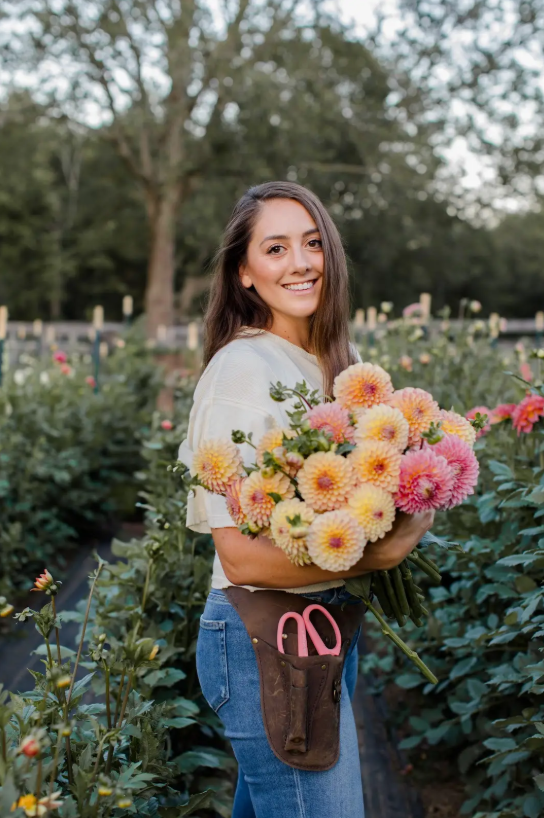
About Christine of Wild Iris Flower Farm
Christine Covino is the founder of Wild Iris Flower Farm in Ridgefield, Connecticut, where she grows sustainably cultivated, designer quality blooms on a small scale with a sharp eye for color, texture, and seasonality. Her farm is known for flowers that feel intentional and elevated, paired with a warm, welcoming approach that helps customers feel confident bringing fresh blooms into their homes.
What makes Wild Iris Flower Farm especially unique is Christine’s vintage 1961 VW flower truck, Elle, a mobile bloom bar that turns flowers into an experience. Through farmers markets, seasonal CSA subscriptions, and hands on workshops, Christine blends farming, storytelling, and community in a way that feels both beautiful and practical. She is also a mother of three who has built a business with smart systems and clear priorities, proving that small scale farming can be both profitable and life giving.
Follow her on Instagram: @wildirisflowertruck
Check out her Website:
www.wildirisflowerfarm.com
She also simplified bouquet recipes. Rather than packing in too many ingredients, she moved toward a few strong elements repeated in a clear pattern. This matters because mixed bouquets are still a top seller for many flower farmers. Customers love them, and if they are priced appropriately, they can be one of the most profitable items you sell. The key is making them repeatable so they do not consume your whole week.
The flower truck is not only cute, it is a marketing engine
Christine’s vintage 1961 VW flower truck is a showstopper, and she is also honest about the realities. Vintage vehicles require maintenance, they have travel limits, and they add logistics that a standard pop up setup does not. If you are considering a truck, it is wise to think through storage, transportation, insurance, and who is actually driving it.
Even with those challenges, the truck plays an important role. It makes the farm memorable. It attracts people who may not have stopped at a standard flower tent, and it builds brand recognition that supports the rest of the business. Christine described it as something that may not be the biggest direct money maker, but it creates exposure that can lead to CSA signups, repeat market customers, and a community that knows your farm by name.
Build the farm that fits your season of life
This episode is a reminder that a sustainable flower farm is not always the one that does the most. It is often the one that does a few things consistently, with solid systems and clear boundaries. Simplifying sales outlets, simplifying bouquet recipes, and simplifying production workflows can create more breathing room while still supporting growth.
If you are in a season with limited childcare, limited daylight, or limited energy, you are not behind. You are building wisely. Small changes like tightening your bouquet station, refining recipes, and cutting one draining revenue stream can make the whole business feel lighter and more profitable.
Want to hear the full conversation? Listen to this episode of the Six Figure Flower Farming podcast with Jenny Marks for more insight and practical steps.
