How Amanda From Flowers on Phoenix Built a More Profitable Flower Farm by Doing Less
A Profitable Flower Farm Should Fit Your Life, Not Take It Over
When most of us first start flower farming, it is really easy to fall into the trap of thinking more is better. More varieties. More beds. More sales outlets. More content. More hours squeezed into an already packed day.
Amanda Keene of Flowers on Phoenix learned pretty quickly that wasn't the kind of flower farm she wanted to build. Today, she grows on only about 5,000 square feet, including her high tunnel, while balancing her business, homeschooling, her family, weddings, workshops, flower preservation, and everything else life throws her way. The goal is no longer to see how much she can possibly grow. It is to make sure what she grows is actually worth the space and time it takes.
Her decision-making has become pretty simple:
Does this crop make enough money to justify its growing space?
Can it serve more than one purpose, such as fresh and dried flowers?
Is there proven customer demand for it?
How much labor does it require throughout the season?
That shift has meant saying goodbye to flowers she genuinely likes. Statice, for example, had multiple uses, but it simply wasn't producing enough revenue for the valuable growing space it occupied. Pretty isn't enough when you're trying to build a profitable flower farm.
Stop Trying to Grow Every Flower
One of the biggest lessons Amanda wishes she'd learned earlier is that you do not need to grow 50 different varieties to have a successful flower business. Social media can make us feel like every farm needs a perfectly curated field overflowing with every flower imaginable, but your customers may be perfectly happy buying the handful of crops you grow exceptionally well.
For Amanda, ranunculus and dahlias continually stood out as two of her strongest crops. Once she started looking seriously at her numbers and talking directly with her customers, the answer became pretty obvious: grow more of what works and stop pouring time into crops that don't. Her customers even confirmed they would happily buy straight bunches of ranunculus. Sometimes we spend months trying to solve a question our customers could answer for us in five minutes.
Before expanding your crop plan, look at:
Revenue: Which crops are actually bringing money into the business?
Expenses: What does each crop cost you in seeds, supplies, infrastructure, and labor?
Time: Which crops require constant babysitting, harvesting, processing, or maintenance?
Demand: What are your customers repeatedly asking for and buying?
The only way to really answer those questions is to know your numbers. Tracking crop sales and expenses gives you the information you need to identify profitable crops, reduce overproduction, and make smarter plans for the following season.
Flower Farm Efficiency Is About Protecting Your Time
Amanda has also gotten much more willing to question the jobs flower farmers are told they are “supposed” to do. One of her biggest examples? She stopped digging all of her dahlias every fall. Instead of automatically spending hours digging, cleaning, dividing, storing, and managing tubers, she experimented with overwintering them in the ground on her Zone 6B Missouri farm. It isn't a strategy that will work for every farm or every climate, but for her operation, it eliminated a huge seasonal workload.
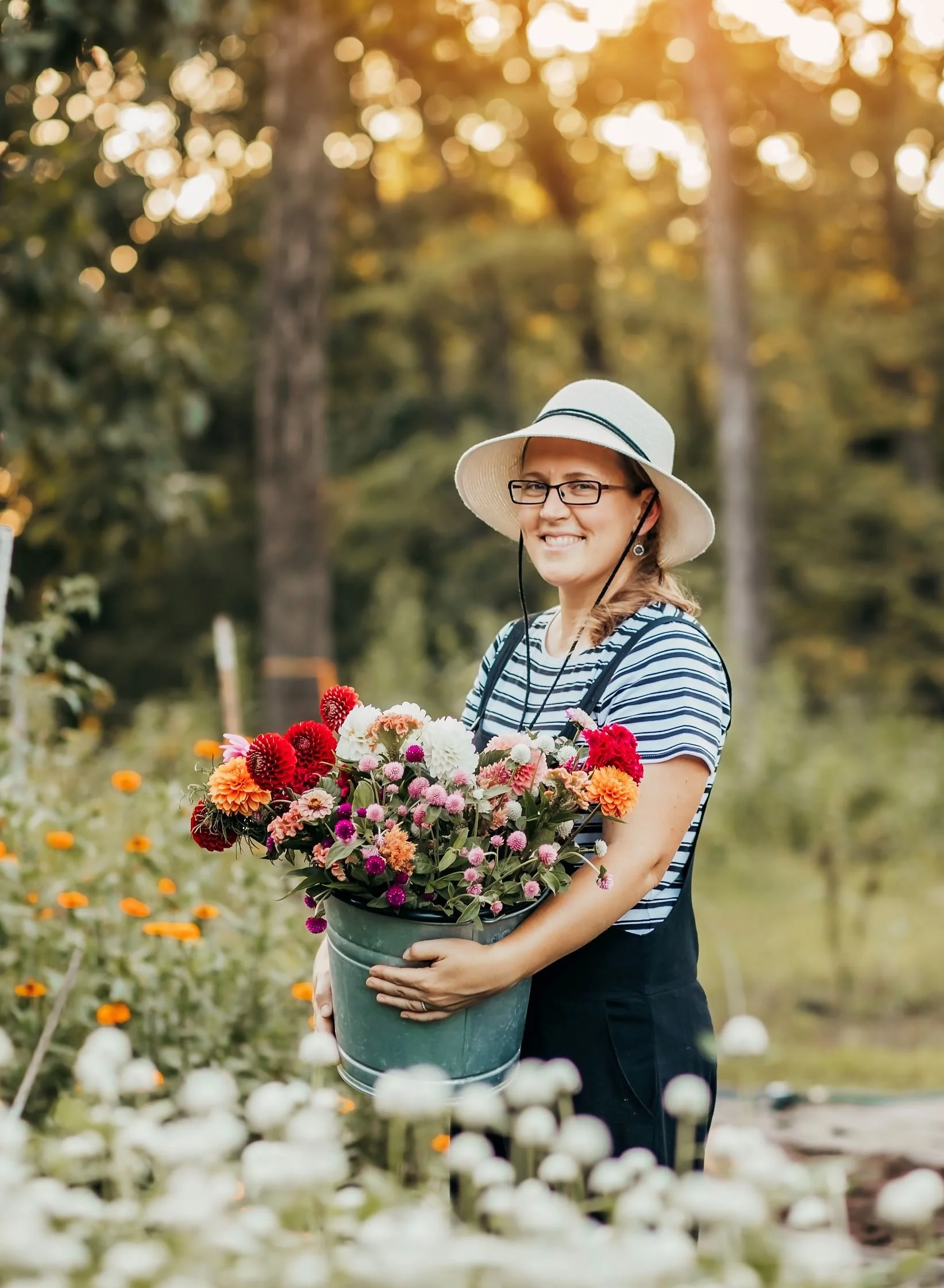
About Amanda Keene
Amanda Keene is the flower farmer behind Flowers on Phoenix, a small but mighty flower farm in Missouri where she grows on roughly 5,000 square feet, including a high tunnel. What started as a U-pick flower farm has evolved into a diversified business that now includes weddings, workshops, flower preservation, subscriptions, and fresh flower sales.
What makes Amanda’s story stand out is how intentionally she has shaped the business around her life and family. A wife, mom of three, and homeschool mom of 16 years, Amanda has become incredibly selective about where she spends her time, what she grows, and which parts of the business are truly worth pursuing. Rather than trying to grow everything herself, she focuses on profitable, multipurpose crops like ranunculus, dahlias, zinnias, and gomphrena, and is willing to source from other local growers when it makes sense.
She has also built strong relationships with her customers through email marketing, community connections, word of mouth, and the kind of personal storytelling that makes people feel like they know the farmer behind the flowers. Her thoughtful, practical approach is proof that a flower farm does not have to be huge, complicated, or all-consuming to be successful.
Amanda is building a business that supports her family, her creativity, and the life she actually wants to live.
Check out Amanda’s website: www.flowersonphoenix.com
Follow her on Instagram: @flowers_on_phoenix
She made a similar change with ranunculus. After years of fall planting and spending winter worrying about freezing temperatures, snow loads, rodents, and tunnel maintenance, she experimented with spring planting and still got results she was happy with. That meant she could protect something else that mattered to her family: their January vacation.
That is the question worth asking again and again on your own farm: Does this actually need to be done this way? Efficiency isn't about cutting corners. It is about identifying the work that produces a meaningful return and getting rid of the work that doesn't.
Your Best Flower Farm Marketing Might Not Be Instagram
Amanda made another surprising discovery when she looked at where her marketing time was actually paying off. Instagram Reels took her forever to create and weren't producing meaningful sales. Email marketing did.
Instead of continuing to pour hours into a platform simply because she felt like she was supposed to, Amanda started focusing more heavily on email, Facebook, customer relationships, and word-of-mouth marketing. She sends newsletters about what's happening around the farm, sometimes talking about flowers and sometimes simply telling funny stories about her ducks. That ordinary, real-life storytelling helps customers feel connected to the person behind the business.
Her marketing priorities became much simpler:
Spend time where her actual customers already are.
Build genuine relationships instead of chasing followers.
Ask customers directly what they want.
Encourage happy customers to tell other people about the farm.
Stop spending hours on marketing activities that aren't producing results.
That relationship-building has paid off far beyond a single bouquet purchase. Customers who originally came to the farm for U-pick flowers have later hired Amanda for weddings. People email, message, and text her directly when they need flowers. One good customer relationship can continue creating sales for years.
Build the Flower Farm Business You Actually Want
There is a line running through Amanda's entire story that I think every flower farmer needs to hear: your business is supposed to fit into your life. Your life is not supposed to disappear into your business.
For Amanda, that means homeschooling comes first. Her family comes first. Her marriage comes first. The flower farm has to work around those priorities, not slowly push them aside. And that has meant starting smaller, simplifying her crop plan, buying flowers from other growers when it makes sense, focusing on profitable work, and accepting that she does not have to personally do everything for the business to be successful.
If your flower farm currently feels like a plate piled so high that, as Amanda puts it, the broccoli is touching the mashed potatoes, it might be time to take something off the plate. You don't necessarily need more crops, more acreage, more followers, or more hours. You may need better numbers, clearer priorities, and permission to focus on the things that are actually working.
Listen to this episode of the Six Figure Flower Farming Podcast to hear my full conversation with Amanda Keene of Flowers on Phoenix, including what she wishes she'd done differently when she started, how she's simplifying her farm, the marketing strategy that surprised her, and how she's creating a profitable flower business that supports the life she wants to live.